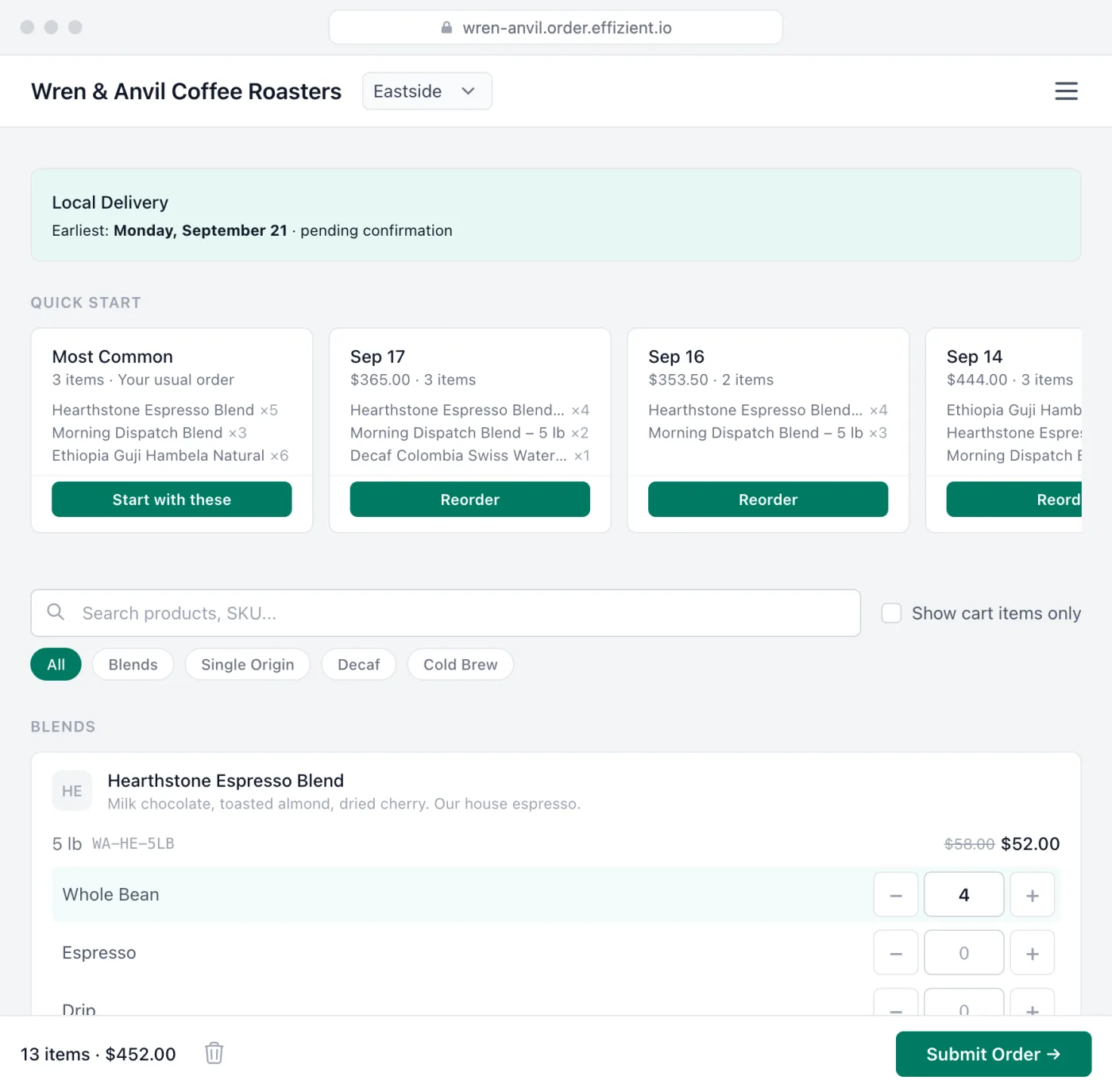
Wholesale ordering for coffee roasters
Stop being the order desk.
Your accounts order from their own portal at their own prices, and phone and email orders land in the same list. Every order becomes an invoice in QuickBooks or Xero, and every payment lands against it. Nothing typed twice.
We set it up and bring your history across, free. Your team keeps prices and accounts current, in one place instead of four.

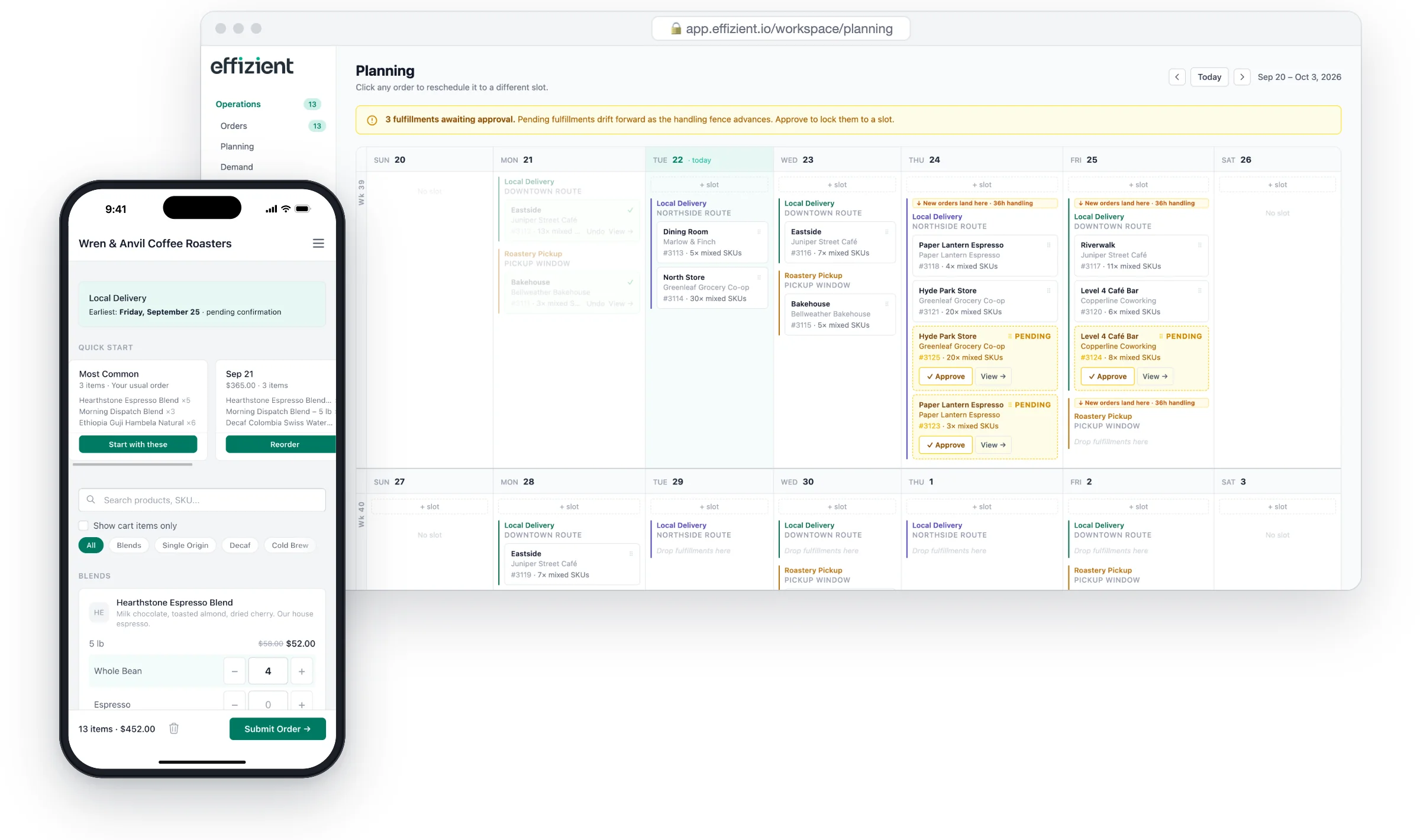
Planning
Click any order to reschedule it to a different slot.Morning Dispatch Blend ×3
Ethiopia Guji Hambela Natural ×6
Morning Dispatch Blend – 5 lb
Decaf Colombia Swiss Water…
How it works
From the order to the books.
Most roasteries run these steps across several systems and a whiteboard, then fix the gaps by hand at month end. Here they are one chain, and each step starts from what the one before it decided.
-
01
Order
Customers order at their own prices, from their own catalog, without calling anyone.
-
02
Demand
Real orders add up to this week's requirement, with blends broken down through their recipes. Not a forecast - what people actually bought.
-
03
Fulfill
Orders land on a board by delivery day, where your team approves, reschedules and fulfills them.
-
04
Invoice
Fulfilling an order sends its invoice to your accounting, due on the location's terms. Accounts pay it online, by bank transfer or card, and the payment is recorded against it. Change the order and the invoice follows.
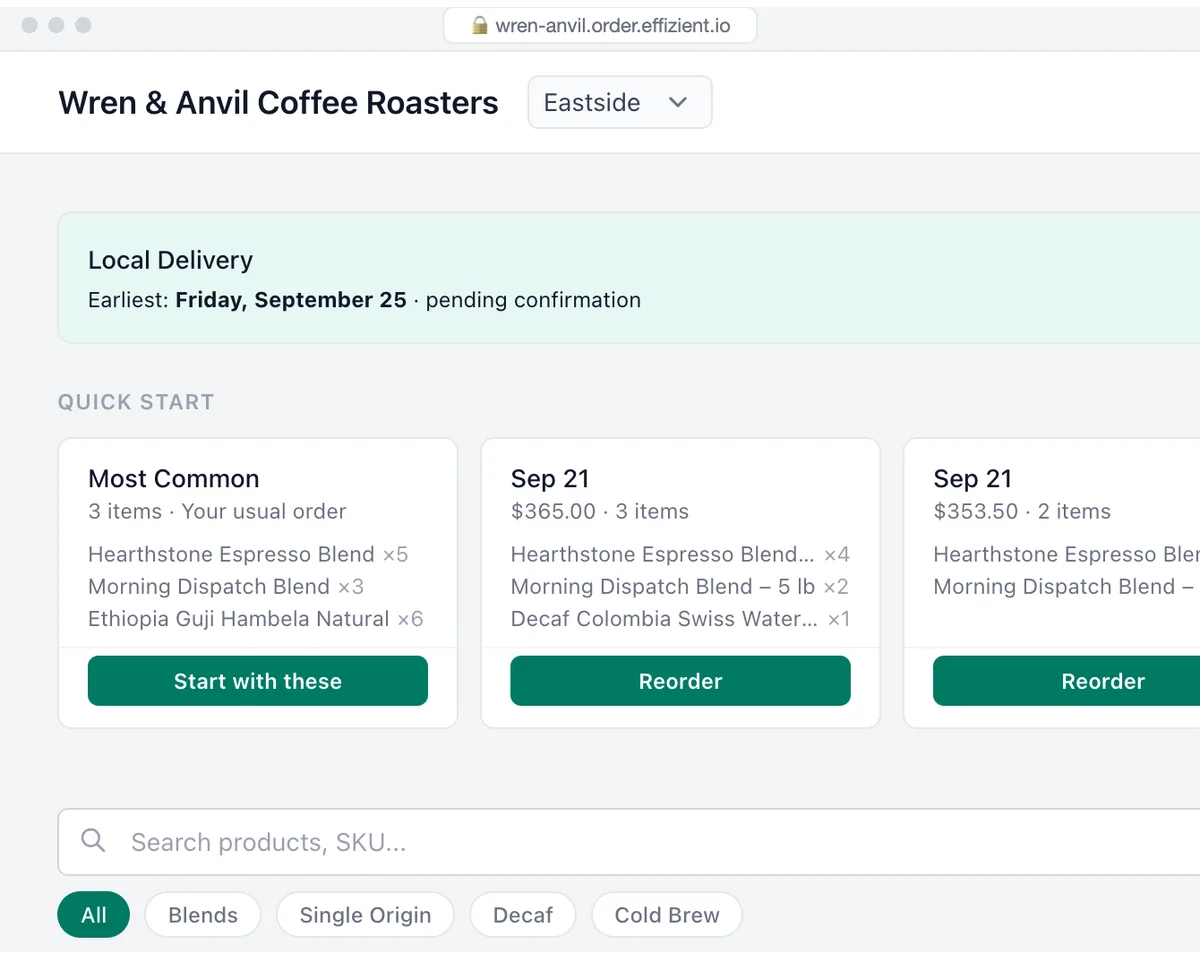
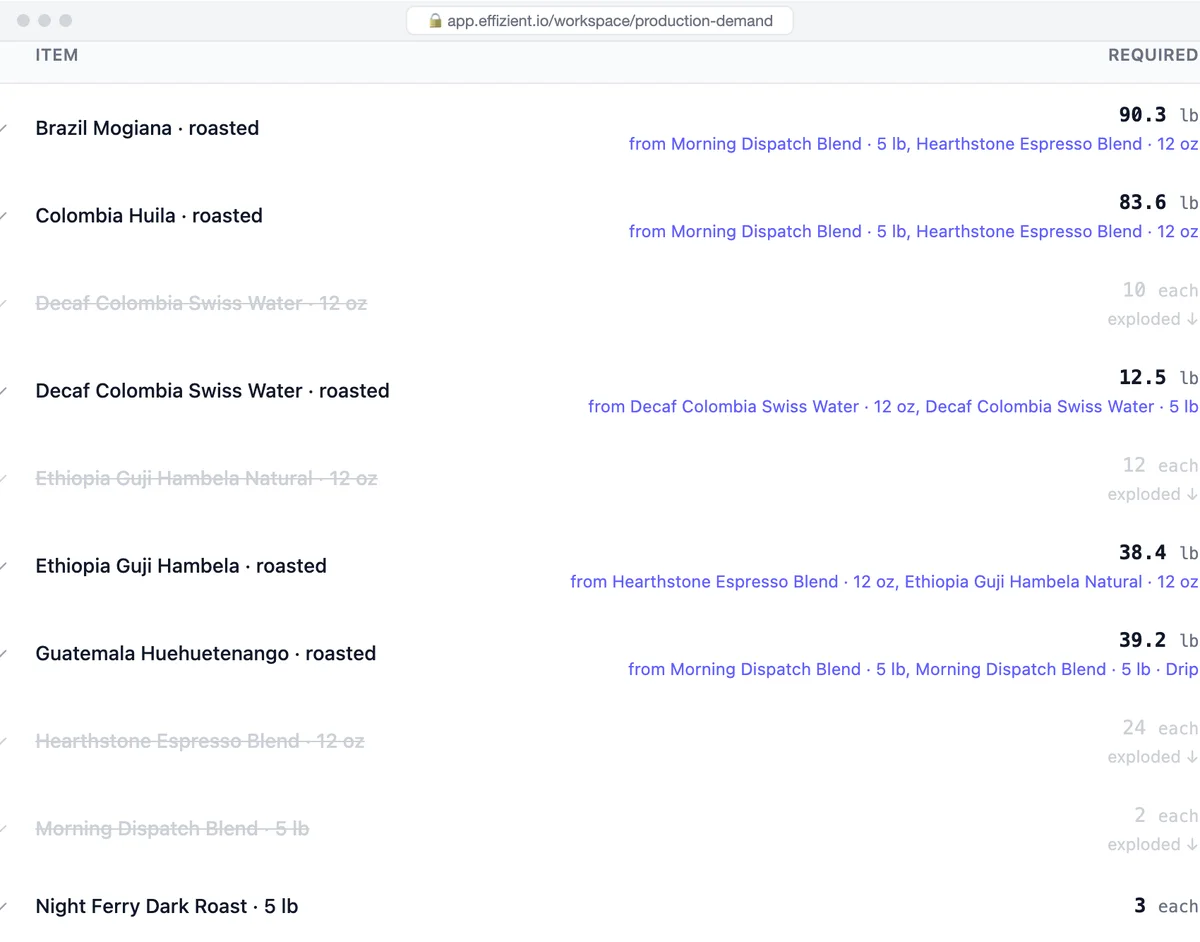
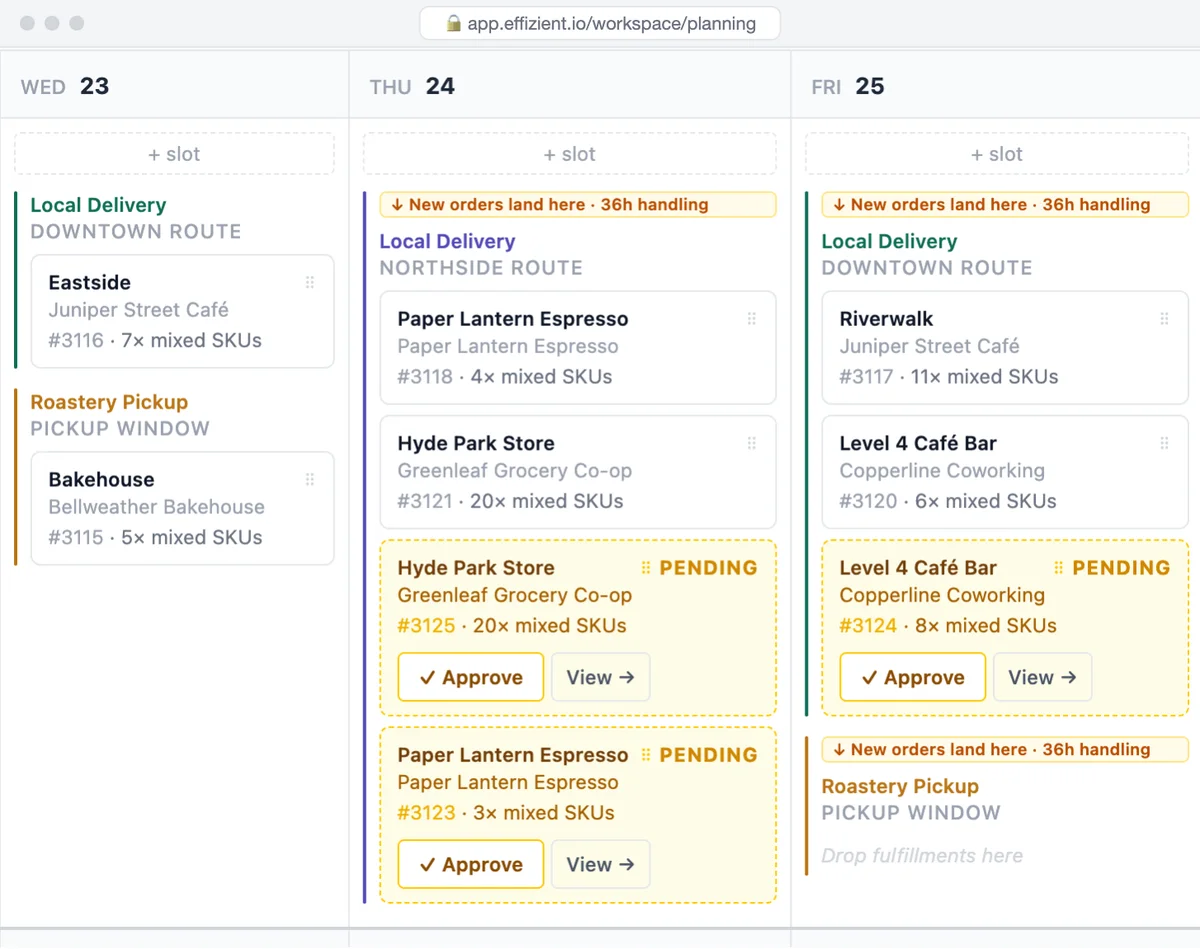
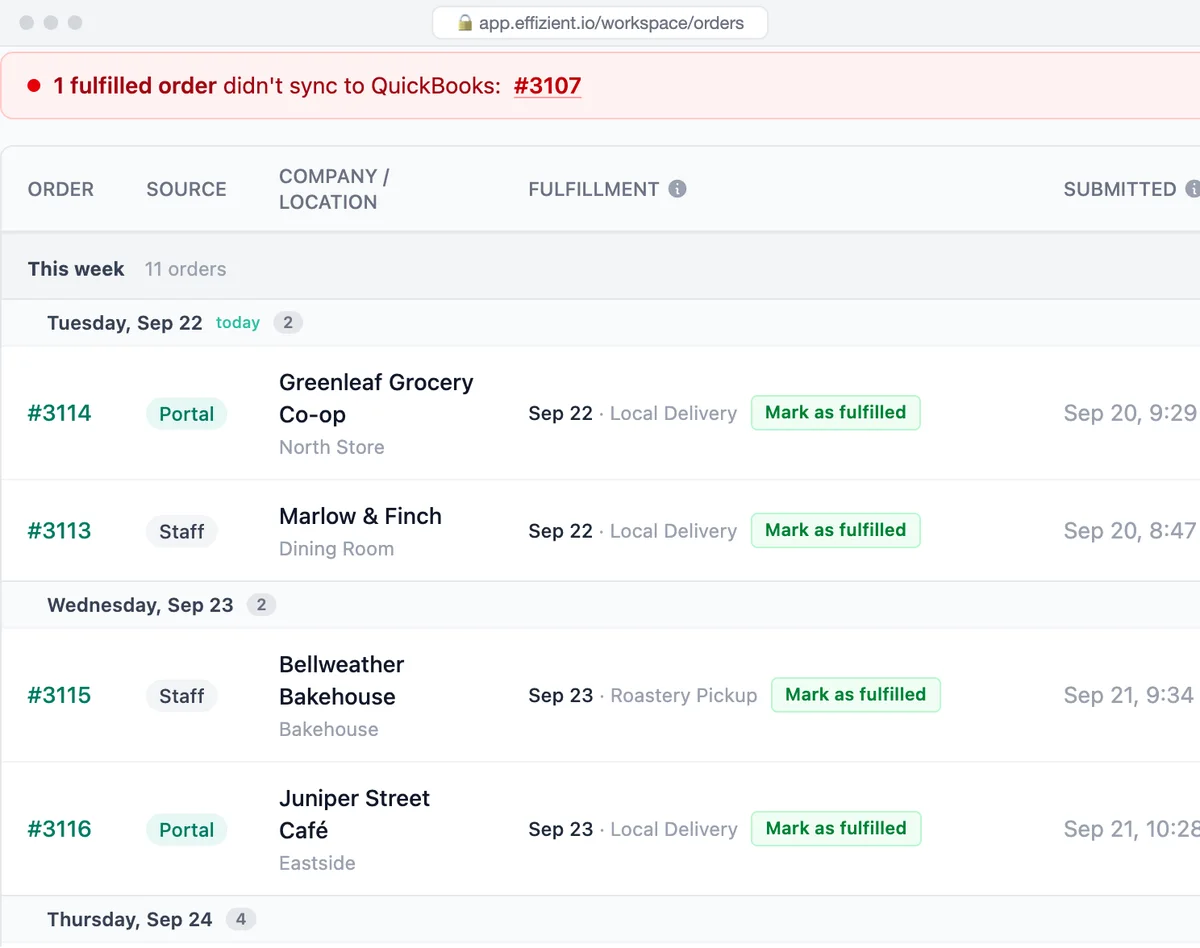
Screens from effizient, shown with sample data.
Your accounting stays the book of record.
QuickBooks or Xero: your accountant keeps working there, and every payment, online or by check, lands against the invoice effizient raised.
Orders that still come by phone
Take the call. The order lands with the rest.
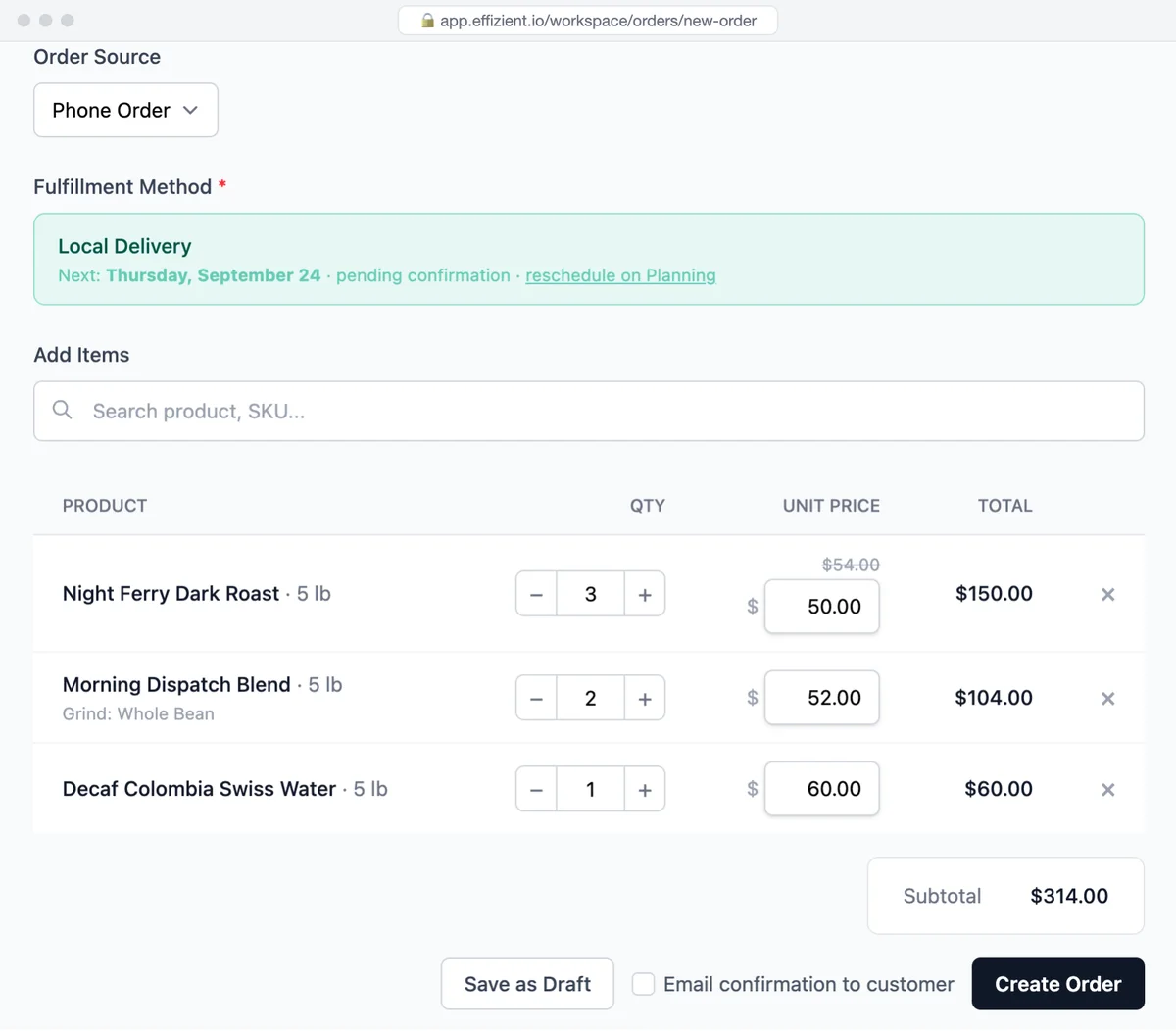
Pick the café, reorder one of their past orders or search for a product, and their own prices fill in. The order goes onto the planning board on its delivery day, the same as a portal order, and into your accounting once it's fulfilled.
Each order is marked as a phone order, so you can see which accounts still call, and who might order online instead.
Questions your current system can't answer
Ask any of these. Get a straight answer.
“Why does this customer pay this price?”
A price that differs from the catalog traces to the override behind it: its label, its notes and the dates it applies.
HOUSE-5LB-WB  $59.38
← Birchwood Group 5 lb bulk, −5%
← applies from 6 Jul 2026
“What do we roast this week, and for whom?”
This week's demand from the orders customers actually placed, with blends broken down through their recipes and every line traced back to the orders behind it.
Wk 38 · 412 lb across 9 blends
← 38 orders from 21 locations
“Did every order make it into the books?”
Every sync to your accounting is tracked. One that fails is flagged on the order and listed on your orders page, before month end finds it.
1,284 invoices sent · 1 needs attention
#4392: QuickBooks item is inactive
Each of these is a screen in effizient today.
In production
A roaster moved its entire wholesale book in ten weeks, against a hard cut-off date.
- 375
- wholesale locations moved
- 9,800+
- orders of history migrated, all linked to the QuickBooks invoice they were billed on
- 0
- days of ordering lost at cutover
Their previous system was ending on a fixed date. On that date the last order was written to it, and every location was already ordering here.
Why roasters
Roasting is one of the harder operational puzzles in food.
Green bought by the lot, months before you know what you will sell. A roast schedule that has to satisfy orders nobody has placed yet. Freshness measured in days rather than quarters. And a wholesale book where every café pays its own price, for reasons that were agreed in person and written down nowhere.
Every generic tool handles one of those and hands you the rest. We built this because that combination is the interesting problem, and it is still where the product goes deepest - and where it stays.
What it replaces
One bill instead of four, and nothing between them to keep in sync.
The cost isn't the subscriptions. It's the hours spent making four systems agree, and the invoices that go out wrong when they don't.
- Order management software
- Wholesale portal, catalogs, per-customer pricing
- The accounting sync add-on
- And it tells you when an invoice didn't make it
- The Monday demand spreadsheet
- This week's demand, from orders people actually placed
- Waiting on checks in the mail
- Accounts pay online, by bank transfer or card
- The pricing that lives in someone's head
- Written down, with the dates it applies
Pricing
Priced on accounts served, not on pounds roasted.
Everyone else in this category prices on volume. Roast 40% more into the same accounts and you fund their roadmap. Here the bill only moves when the business you are running gets bigger, not when the year goes well.
Plans from
$153 a month
Priced by the number of wholesale locations you serve. The plan for your size comes on the call.
Pay by ACH bank debit and every plan costs less, from $149 a month.
When your accounts pay online: bank transfer 1% + $1 (never more than $20), card 3.5% + 20¢, Stripe's fees included.
- Every step on one plan - nothing is an add-on
- Setup and migration of your full history, free
- No minimum term: cancel any month if it isn't a fit
- Your full data exported on request, at no charge
Who this is for
A good fit
- Coffee roasters with a real wholesale book
- Taking orders by email, text and phone, then typing them up
- Keeping QuickBooks or Xero as the book of record
- Want one record instead of four systems
Not a fit
- Roasters who sell only direct to consumers
- Looking to replace your accounting system, not keep it
- Shopping for roast profiling software
- After a point-of-sale system for their cafés
Book a 20-minute call
Tell us how you run wholesale today.
Twenty minutes, no slides: what you use now, where orders and invoices slow you down, and when your current contract is up. If effizient looks like a fit, the next step is a walkthrough set up with your own products and pricing. If it doesn't, we'll say so.
- Switching soon?
- Bring your contract end date, and we'll walk through how a move works, step by step, and how long it takes.
- A direct line, not a ticket queue
- Onboarding and support come from a named contact who knows the system inside out. You hear back within one business day.
- Who you'll talk to
- Michael Wallbaum, who founded effizient. He's from Bremen, where Germany's first coffee house opened in 1673, got hooked on specialty coffee as a startup co-founder and CTO, and spent the years since building wholesale, delivery and financial systems for other businesses.
Based in Austin, Texas.
Thanks, .
Your note is with us. You'll hear back within one business day, from a named contact who knows the system inside out.